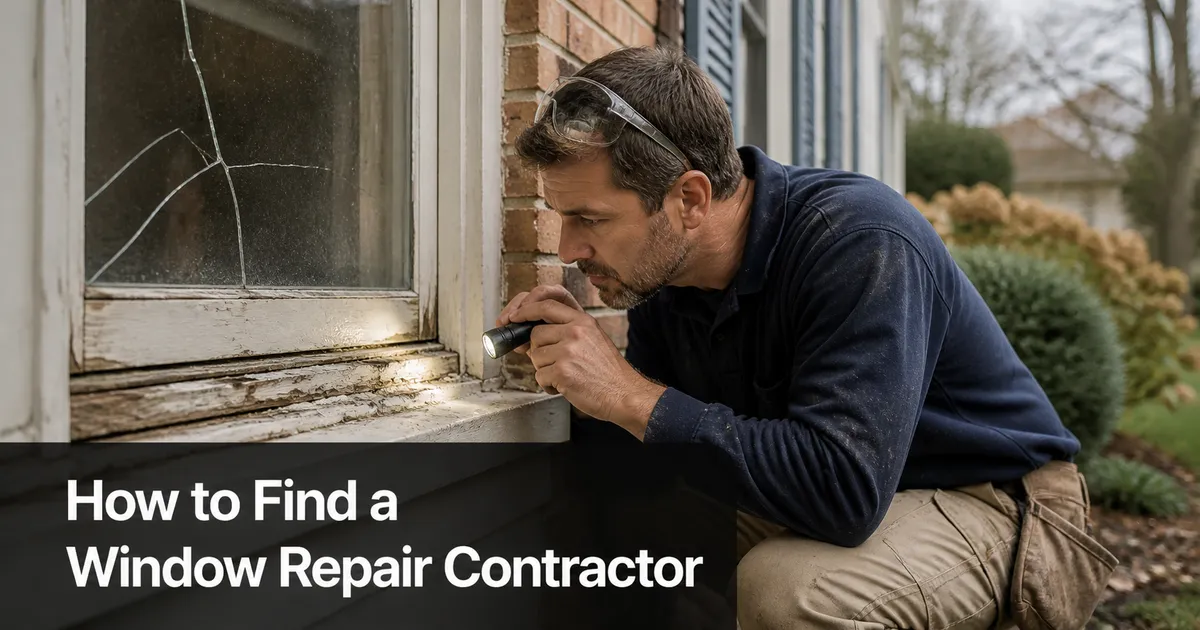
Scope-honest vs. upsell-pressure — what the difference looks like
The window repair industry runs on two distinct contractor profiles. Most repair contractors — glaziers, multi-trade contractors with window-repair services, and replacement contractors who also handle repair scope — do what you'd expect: they assess what's failing on your specific window, quote the work to fix that specific failure, and execute. The minority profile uses the same assessment visit as a sales conversation, pivoting from your stated repair scope to a full-replacement quote that's typically 10–20× the cost of the repair you originally called about.
The behavioral patterns that distinguish the two profiles are visible almost immediately:
- Scope-honest: arrives, asks what specifically is failing, looks at the failed component, names the repair (failed IGU seal → replace the IGU; broken sash cord → replace the cord; degraded weatherstripping → replace the gasket), quotes the per-window cost, and books the work. Total assessment time: 15–30 minutes per window.
- Upsell-pressure: arrives, takes a "comprehensive look at all your windows" without being asked, points out condensation patterns / paint wear / minor sash play on neighboring windows, frames the result as "while we're here we should really look at the whole picture," and produces a replacement quote rather than a repair quote. Total assessment time: 60–90 minutes, of which the actual failed-component assessment is maybe 10.
The honest version of the upsell-pressure profile's argument exists — there ARE situations where a single failed window is the canary for an installation approaching end-of-life across the board, and replacement IS the right scope in those cases. The repair vs. replace decision framework documents the 5-question diagnostic for distinguishing those situations from cases where the failure really is isolated. Run that framework before booking any contractor's assessment visit — going in with your own diagnosis means you can recognize when the contractor's "you should replace everything" recommendation matches your situation versus when it's pattern- matching upsell behavior independent of what your windows actually need.
The screening signal: if the contractor's first response to your stated repair scope is to suggest a bigger scope without first looking at the specific failure you called about, you're talking to the upsell-pressure profile. End the conversation politely and book the next contractor's visit — the assessment hour you'd have spent with the first contractor is the clearest signal you'll get about what kind of contractor relationship the rest of the project would have looked like.
Where to find repair contractors
The window-repair market sits across three distinct contractor types, and the right one for your project depends on what's failing. Knowing which type to call first saves you the wasted visits with contractors who would have been wrong for your scope anyway.
- Glaziers — for glass-only failures. A glazier is a glass specialist who works with insulated glass units, single-pane glass replacement, mirror work, and shower-door installation. For failed IGU seals (the most common dual-pane window failure), broken panes, or any glass-specific problem, a glazier is the fastest + most cost-effective contractor. Sourcing channels: search "glazier near me" plus your city, OR ask your window manufacturer's customer service for their referral list (manufacturers often have certified-glazier networks for warranty work). Typical scope: in-and-out within 1–2 weeks of the assessment visit.
- General handymen with window-repair experience — for hardware + weatherstripping. Window hardware (sash cords, balances, locks, cranks) and weatherstripping replacement are within the scope of any competent handyman with window-specific experience. The qualifier matters: a handyman who installs ceiling fans and patches drywall is not necessarily the right contractor for window hardware work. Ask explicitly about window-specific experience + recent window-repair references. Sourcing channels: local handyman services with verified reviews mentioning window work, OR contractor referrals from neighbors who've had similar repairs done. Typical scope: same-day or next-day work for small repairs.
- Window-replacement contractors who also offer repair — for multi-component repairs OR when you're not sure of the scope. Most window-replacement contractors have a repair division that handles in-warranty work + larger repairs that don't justify a glazier's specialist visit. The advantage: they can quote both repair AND replacement scope in the same visit, letting you see the comparison directly. The disadvantage: this is the contractor type most likely to surface the upsell-pressure profile from the previous section, so the screening signal there matters most when calling this category. Sourcing channels: the same window-replacement contractors a homeowner would call for a full-replacement project. Typical scope: 2–4 weeks from assessment visit to completed repair work, depending on parts availability.
For most single-issue repairs, start with a glazier — fastest scheduling and lowest per-issue cost. For multi-issue repairs OR for cases where the right scope isn't clear, start with a window-replacement contractor whose repair division can quote both paths.
5 questions to ask before booking the assessment visit
Before any contractor earns an in-home assessment slot, the same 5 questions run on the phone surface the scope-honest profile from the upsell-pressure profile in under 15 minutes per call. Most reputable repair contractors answer all five confidently; contractors who deflect, hedge, or pivot to "we'll explain when we come out" are signaling the pattern that section 1 named. The National Association of Home Builders maintains contractor-finding guidance and recommends verifying state licensing before any contract is signed — the framework below operationalizes that verification.
Are you licensed and insured in this state?
Honest answer: a state contractor license number you can verify on the licensing-board website plus a current general liability insurance certificate, deliverable within 24 hours. Red-flag answer: "we'll get you that when we come out" or vague references to being "licensed and bonded" without specifics. For pre-1978 homes, also confirm EPA RRP certification — required for any repair work that disturbs paint.
Do you specialize in repair, or is repair a sideline of your replacement business?
Honest answer: a clear statement of which category they're in (glazier or repair-specialist handyman lead with repair; replacement contractors run repair as a service line). Red-flag answer: deflecting the question or pivoting immediately to "let us come out and look at everything." Both business models are valid; the contractor's answer just tells you which category's screening discipline applies — and which upsell pattern to watch for.
Do you bill per visit or per repair scope?
Honest answer: per repair scope (failed IGU = $X, hardware replacement = $Y) plus a standard service-call fee for the assessment visit if no work is booked. Red-flag answer: "we bill by the hour" without a per-scope fixed quote (exposes you to time-padding), or a single all-in number without itemizing scope (exposes you to scope-padding). Ask for the itemization explicitly before the visit.
Do you charge a service-call fee for the assessment visit?
Honest answer: a clear upfront statement — either "free assessment" (typical for replacement contractors recouping the cost in $5,000+ projects) or a $0–$150 service-call fee credited toward the project if you book the work (typical for repair specialists). Red-flag answer: evasion, or a fee mentioned for the first time when the contractor arrives at your door. Both pricing models are honest; the question is whether the contractor tells you upfront.
What's your warranty on repair work?
Honest answer: 90 days to 2 years on the specific component repaired, in writing, with separate disclosure of the manufacturer's IGU warranty (often 10–20 years on the IGU itself). Red-flag answer: "we stand behind our work" without a written warranty term, or a verbal promise to "make it right if there's a problem." Industry installation standards from the Fenestration and Glazing Industry Alliance (FGIA) are the reference contractors who do professional-grade work cite — written workmanship warranties are part of that standard.
Run these 5 questions on every contractor BEFORE booking their assessment visit. The 15-minute phone screen surfaces the hard-pass cases without consuming an in-home visit slot. The contractors who pass all five are the ones who earn the assessment visit; the contractors who deflect on any of the five have already given you the answer about how the rest of the project would have gone.
Red flags during the assessment visit
Phone-screen questions filter out about 70% of the upsell-pressure profile. The remaining 30% surface in person, when the contractor is in your home and the conversation is harder to end politely. Five red flags worth recognizing in the first 15 minutes of the visit:
- The "while we're here" comprehensive look. The contractor was called for one specific failed window but starts walking room-to-room examining other windows that aren't on the work order. The honest version of this exists when the contractor wants to make sure they're not missing related failures; the upsell version pivots from "I see some patterns I should mention" to a full-replacement quote within 20 minutes. The screening signal is whether the contractor asks permission first ("would you like me to look at the others while I'm here?") or just starts looking.
- The "this needs replacement, not repair" pivot without a written diagnosis. If the contractor recommends replacement instead of the repair you called about, ask for the written diagnosis: which specific component is failed beyond repair, and why. The honest version produces a 2-paragraph written explanation pointing at specific evidence (rotted frame measured at X depth, IGU seal failure on Y windows, hardware that's been discontinued and can't be sourced for repair). The upsell version produces "trust me, you should replace these" without specifics. The repair-vs-replace decision framework covers when each scope is correct; if the framework says repair on most of your windows and the contractor pushes replace, get a second opinion before signing anything.
- "Today only" pricing or seasonal-sale urgency. Repair contractors don't run flash sales any more than replacement contractors do. Repair pricing is based on per-component cost (the IGU costs what it costs from the manufacturer, regardless of which day you book the visit). "If you sign today I'll knock $X off" pricing is either padding that exists to be discounted off, or a sales tactic to skip the comparison-quote process.
- Pressure to add work that wasn't on the original quote. Once the contractor is in your home and looking at the failed component, they may identify additional work (recommended weatherstripping replacement, suggested sash hardware upgrade, exterior trim repair). Some additions are legitimate; some are scope-creep. Ask for written line items for any addition before agreeing — verbal agreements at the assessment visit are the most common source of mid-project scope disputes.
- Quote that requires immediate signature. Honest repair contractors leave a written quote that's valid for at least a week, giving you time to compare quotes and decide. A contractor who frames the quote as "this is good only while I'm standing here" is using urgency to skip the comparison process. If the diagnosis genuinely lands at replacement and the conversation needs to shift to replacement scope, the how to hire a window installer framework covers that path — but only after a second opinion confirms the replacement diagnosis.
The cost arithmetic is straightforward. Recognizing a red flag during the assessment visit costs you 15 minutes of awkward conversation ending the visit and the time spent calling the next contractor. Discovering the same red flag mid-project — a $250 repair scope ballooning into a $12,000 replacement that wasn't actually needed — costs $11,750 plus the time wasted on work that didn't have to happen. The math on ending the conversation early is straightforward.
Frequently asked questions
- How do I know if my window needs repair or replacement?
- Three quick diagnostics surface the answer. First, age — if the window is under 15 years old and only one specific component has failed (broken sash cord, failed IGU seal, cracked pane, broken hardware), repair is almost always correct. Second, scope — if 7+ windows are showing the same failure mode at once, the installation as a whole is failing and replacement starts to make sense. Third, frame integrity — if the wood frame is rotted or the vinyl frame is warped, repair is cosmetic; the structural component is gone. The repair-vs-replace decision framework on the cost-guide cluster walks the full 5-question diagnostic; run it before booking any contractor's assessment to anchor the conversation in your own scope rather than the contractor's.
- What does window repair typically cost?
- Repair costs depend on what's failing. Failed IGU (insulated glass unit) seal — $150–$400 per IGU. Sash replacement (operable glass + frame, keeping the exterior frame in place) — $250–$650 per window. Weatherstripping replacement — $75–$200 per window. Hardware replacement (sash cords, locks, balances, cranks) — $100–$300 per window. Cracked pane on a single-pane window — $100–$350. Spot frame repair (small rot patch) — $200–$500 per window. Most single-issue repairs land in the $75–$650 per-window range; multiple stacked issues on one window can push into the $500–$900 range, at which point the math starts to argue for replacement instead.
- Can any contractor repair windows or do I need a specialist?
- It depends on what's failing. Glass-only failures (IGU seal failure, cracked pane) are typically handled best by a glazier — a specialist who works with glass daily, has manufacturer accounts for replacement IGUs, and can often complete the work in one visit. Frame, hardware, and weatherstripping repairs can be handled by a general handyman with window-repair experience OR by a window-replacement contractor's repair division. The judgment call: small isolated repairs go to a glazier or handyman (fastest scheduling, lowest cost); larger multi-component repairs go to a window-replacement contractor who can quote both repair and replacement scope and let you see the comparison. Avoid hiring a contractor without window-specific experience — flashing details, sash alignment, and weather-seal practices are window-specific skills that general carpenters often miss.
- What are red flags when hiring a window repair contractor?
- Five red flags worth ending the conversation over: (1) the contractor pivots from your stated repair scope to a full-replacement quote without first looking at the specific failure you called about; (2) the contractor refuses to itemize the repair quote (no per-component breakdown, just one all-in number); (3) the contractor offers a meaningfully discounted price contingent on signing today; (4) the contractor can't produce proof of license + general liability insurance within a day of the request; (5) the contractor wants 50%+ of the project total upfront. Standard residential repair work runs 10–30% deposit at signing, balance on completion. Anything outside that range is a risk pattern that has surfaced in contractor-fraud reports for decades.
Getting a repair quote?
The calculator shows what full replacement costs for your state and window count — so you know whether the repair quote is the better deal before you commit.
Estimate replacement costNo email required. Results show in your browser; no data sent to our servers.